
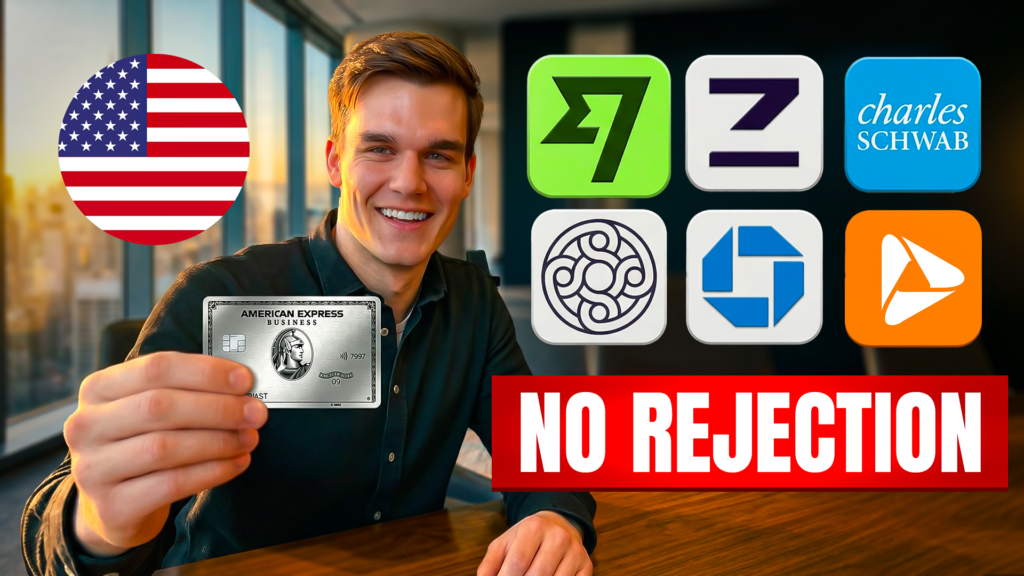
Opening a US bank account as a non-resident is much more possible than most people think.
You do not always need US citizenship, a Social Security Number, or even a US address. The right option depends on what you actually need the account for.
Some people only need USD banking to receive payments from US clients. Others need proper US business banking for an online company. And some want a real personal US bank account to build US credit history, qualify for credit cards, or access US financial products.
Below are the most practical ways to open a US bank account as a non-resident, ranked from easiest to most difficult.
Fintech USD Accounts: The Easiest Option
The easiest way to get access to USD banking as a non-resident is through fintech platforms.
Services like Wise and Revolut allow many non-US residents to open accounts remotely, verify their identity online, and receive USD account details.
With Wise, for example, many users can receive:
- A US routing number
- A US account number
- USD payment details
- International transfers
- Currency conversion
- Debit card access in supported countries
This can be enough if you simply need to receive payments from US companies or platforms.
For example, if you work with US affiliate networks, freelance clients, or platforms that only pay into US bank details, a fintech USD account can solve that problem quickly.
Best For
This option is best if you need:
- Basic USD banking
- A way to receive US payments
- Low-cost international transfers
- A fast online setup
- No US company or US travel
Limitations
The main limitation is that these are not real US bank accounts.
Wise, for example, is not a traditional bank. It is an Electronic Money Institution, also known as an EMI.
That means:
- You are not building US credit history
- You cannot access US credit cards
- You are not entering the traditional US banking system
- Account availability varies heavily by country
- Some countries receive limited features or no USD details
Fintech platforms are excellent for payment processing, but they are not the same as having a full US bank account.
Bottom Line
If you only need to receive USD payments and transfer them to your local bank account, fintech solutions are usually the fastest and easiest option.
But if you need proper business banking, credit history, or traditional US banking access, you will need one of the next methods.
US Business Bank Account Through an LLC
For online entrepreneurs, one of the strongest options is opening a US business bank account through a US LLC.
This is usually the best route if you are running an online business and want proper US business banking.
The structure is simple:
- Form a US LLC
- Get an EIN from the IRS
- Use the LLC to open a US business bank account
This may sound complicated, but forming a US LLC as a non-resident is relatively straightforward.
Best Banks for This Method
Two of the most popular options are:
- Mercury
- Relay
Both allow many non-residents to open US business accounts online using a US LLC.
They offer:
- Online applications
- Modern dashboards
- Virtual debit cards
- Business payment tools
- Multi-user access
- US account details
- FDIC-insured partner banking coverage
Mercury can offer coverage up to $5 million, while Relay can offer coverage up to $3 million through their partner bank networks.
How the Process Works
To open this type of account, you usually need:
- US LLC formation documents
- EIN number
- Business description
- Owner identification
- Basic information about your customers and activity
The application itself is usually simple and can often be completed online in under 30 minutes.
In many cases, approval happens within one to two business days.
Costs
Forming a US LLC online typically costs around $300 to $400, depending on the state and provider.
Popular states include:
- Wyoming
- Delaware
- New Mexico
Wyoming is often popular with non-residents because of its low annual costs, privacy, and simple maintenance.
Limitations
This method is for business banking only.
It will not help you build personal US credit history, and it will not give you a personal US checking account in your own name.
Also, platforms like Mercury and Relay do not support every country. Applicants from certain countries may not be eligible.
Bottom Line
If you run an online business, e-commerce store, agency, consulting business, or international company, this is often the best overall option.
You get real US business banking access without needing to visit the United States.
Puerto Rico Banks: Low-Barrier US Financial Access
Puerto Rico banks are a more unique option.
Puerto Rico is a US territory, so banks based there can connect to the US financial system and provide USD banking with US routing numbers.
This can be useful for people who need access to the US financial system but are not eligible for other options.
Popular Puerto Rico Banking Options
Some of the better-known banks in this category include:
- Zenus Bank
- FV Bank
- CB International Bank
These banks often offer remote account opening and may support a wider range of countries than mainland US banks or fintech platforms.
Why This Option Exists
For applicants from countries like India, Ghana, Bangladesh, and other regions where many fintech or US banking options are restricted, Puerto Rico banks may be more accessible.
For example, some Puerto Rico banks accept residents from over 150 countries.
That makes them useful as a low-barrier entry point into USD banking.
Main Advantages
Puerto Rico bank accounts can offer:
- Remote opening
- Personal account options
- USD banking
- US routing numbers
- No US SSN requirement
- No local US address requirement in many cases
This makes them easier to access than traditional US banks.
Main Downsides
The biggest issue is safety and regulation.
Puerto Rico banks are generally not protected by FDIC insurance in the same way mainland US banks are.
That means if the bank fails, your funds may not have the same government-backed protection.
Some banks also charge monthly fees. For example, Zenus has charged around $20 per month.
Bottom Line
Puerto Rico banks can be useful if you need a low-barrier way to access the US financial system.
However, they should mainly be used as payment gateways, not as places to store large amounts of money.
Receive funds, use the account when needed, and transfer larger balances to a more secure main bank account.
Charles Schwab: Remote Personal US Banking
If you want a legitimate personal US account that can be opened remotely, Charles Schwab is one of the strongest options.
Technically, you are opening an international brokerage account, but the account can also give you access to personal banking features, including a debit card and checking-style functionality.
This makes Schwab one of the best options for non-residents who want personal US financial access without traveling to the United States.
Why Charles Schwab Is Interesting
Charles Schwab offers:
- Remote account opening
- No US address requirement in many cases
- A personal account in your own name
- Access to US investments
- Debit card access
- Excellent international ATM benefits
The debit card is especially strong for international use because it can offer:
- No foreign transaction fees
- ATM fee reimbursements
- Global usability
Insurance and Protection
Because Schwab’s international account is technically a brokerage account, it is generally protected through SIPC insurance rather than FDIC insurance.
SIPC is not the same as FDIC, but it serves a similar protective role for brokerage accounts.
ITIN Requirement
One important point is that Schwab may require either:
- SSN
- ITIN
As a non-resident, you usually will not have a Social Security Number. That means an ITIN is often the practical route.
An ITIN stands for Individual Taxpayer Identification Number. It is essentially a tax identification number for non-US persons.
You can apply directly through the IRS, but this may involve sending your passport physically. Because of that, many people use certified acceptance agents to handle the process remotely.
Alternative: Alliant Credit Union
Another similar option is Alliant Credit Union.
They may also support remote opening for non-residents in some cases, but an ITIN is usually required.
Bottom Line
If you want a real personal US banking-style account without traveling to the US, Charles Schwab is one of the best options available.
It is especially useful if you also want access to US investments and a strong international debit card.
Traditional US Banks: The Most Complete Option
The most difficult option is opening an account with a major traditional US bank.
This includes banks like:
- Chase
- Bank of America
- Wells Fargo
- Citibank
- PNC Bank
This route requires the most preparation, but it also gives you the most complete access to the US financial system.
What You Need
To open a traditional US bank account as a non-resident, you usually need:
- Passport
- Second form of ID
- ITIN
- US phone number
- Proof of address or acceptable alternative documentation
- In-person branch visit
Traditional US banks generally do not offer remote account opening for non-residents.
You normally need to visit a branch in person.
Why This Method Is Valuable
Once approved, you get a full personal US checking account with a major US bank.
This can help you:
- Build US banking history
- Apply for US credit cards
- Build US credit score
- Access loans in the future
- Diversify your banking geographically
- Establish stronger ties to the US financial system
For people who want long-term US financial access, this is the strongest option.
Strategy for Non-Residents
A smart strategy is to start with a more flexible bank first.
Some banks may be easier for non-residents than others. For example, PNC Bank may sometimes be more flexible depending on the branch and documentation.
Once you have one traditional US account, you can use that account history and bank statements to apply with stricter banks later.
This can make it easier to eventually open accounts with larger institutions like Chase or Bank of America.
Best Cities to Visit
If you are opening an account in person, it helps to visit cities with large international populations.
For example:
- Miami
- New York
- Los Angeles
Bankers in these cities are often more familiar with non-resident clients and international documentation.
Bottom Line
This method makes sense if you are already visiting the United States or if your business and income have reached a level where full US banking access is worth the effort.
It is the hardest route, but it gives you the strongest long-term banking benefits.
Which US Bank Account Should You Choose?
The best option depends on your specific situation.
If You Only Need USD Payments
Use a fintech account like Wise or Revolut.
This is the easiest option if you only need to receive USD and transfer it to your local account.
If You Run an Online Business
Use a US LLC with Mercury or Relay.
This gives you proper US business banking and a professional setup for international operations.
If You Are From a Restricted Country
Consider Puerto Rico banks.
They may be more accessible when other platforms reject applicants from your country.
However, avoid storing large balances there.
If You Want Remote Personal US Banking
Consider Charles Schwab.
This is one of the strongest personal account options that can be opened remotely by eligible non-residents.
If You Want Full US Banking and Credit Access
Visit the US and open an account with a traditional bank.
This is the best route if you want to build US credit history, apply for credit cards, and develop long-term access to the US financial system.
Final Thoughts
There is no single best US bank account for every non-resident.
The right choice depends on what you actually need.
If you only need basic USD payments, a fintech account is probably enough.
If you run a business, a US LLC combined with Mercury or Relay is usually the strongest option.
If you want personal US banking without traveling, Charles Schwab is one of the best options available.
And if you want the full traditional US banking experience, including credit cards and long-term credit history, visiting the US and opening an account in person is still the most complete route.
The key is not just opening any account.
The key is choosing the account that matches your actual goal, whether that is payment processing, business banking, personal banking, investing, or building long-term access to the US financial system.