
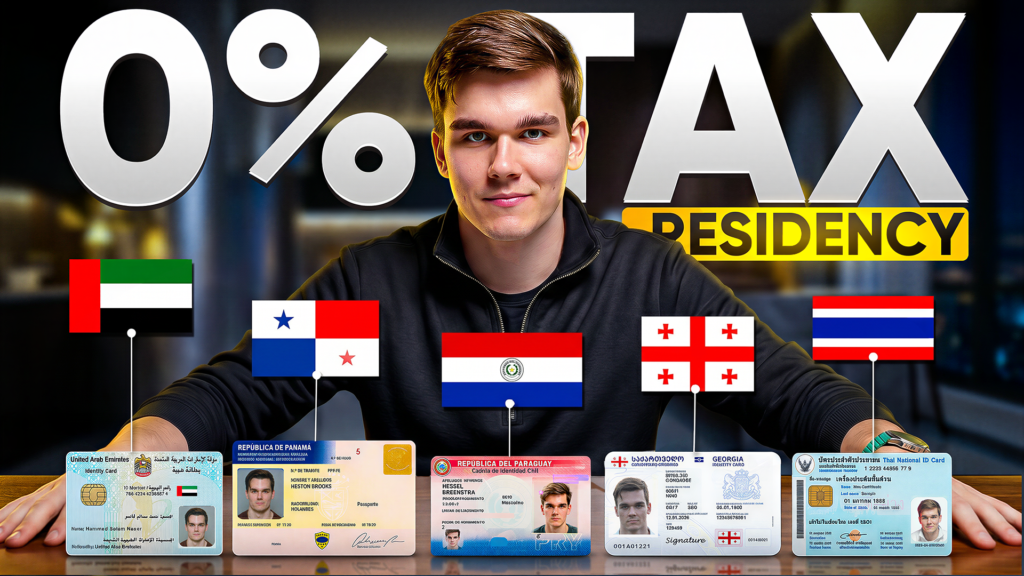
Why More Entrepreneurs Are Leaving High-Tax Countries
Europe has increasingly become a difficult place for entrepreneurs and online business owners.
High taxes, growing regulation, strict banking compliance, and increasing pressure on self-employed individuals have pushed many people to explore international alternatives.
If all your income, business operations, and residency are tied to a single country, you are fully exposed to that system.
For many entrepreneurs, especially those earning somewhere between $100,000 and $500,000 per year, this creates a frustrating middle ground. You may already be paying 40% or more in taxes, but not earning enough to justify expensive offshore structures or highly complex international planning.
This is where low-tax and territorial-tax residencies become interesting.
By combining the right tax residency with the right company structure, it is often possible to legally reduce taxes, improve banking access, and gain more flexibility over where and how you live.
Below are some of the easiest and most practical low-tax residencies available in 2026 for online entrepreneurs, freelancers, and remote business owners.
Paraguay: The Ultimate Backup Residency
How Paraguay’s Tax System Works
Paraguay has become one of the most popular residency options for internationally-minded entrepreneurs, mainly because of how simple and flexible the system is.
The country operates on a territorial tax system, meaning Paraguay only taxes income earned locally inside the country.
If your income comes from foreign clients, online businesses, e-commerce, freelancing, or offshore companies, that foreign income is generally not taxed in Paraguay.
A common structure looks something like this:
- A US LLC, Hong Kong company, or offshore entity earns the business income
- Business banking remains outside Paraguay
- The individual becomes a Paraguayan tax resident
- Foreign-earned income stays outside the Paraguayan tax net
This setup is especially attractive for digital entrepreneurs and location-independent business owners.
The “Insurance Residency” Advantage
One of Paraguay’s biggest advantages is flexibility.
Unlike countries such as Cyprus or the UAE, Paraguay does not impose strict annual physical presence requirements to maintain tax residency.
In practice, many people travel to Asunción, apply for temporary residency, receive their cédula (national ID card), and then maintain residency without spending large portions of the year in the country.
Because of this, Paraguay is often referred to as an “insurance residency.”
It gives entrepreneurs a legitimate tax residency and stable legal address in the background while still allowing them to travel freely between countries.
For digital nomads or perpetual travelers, this can make banking, compliance, and international structuring significantly easier.
Banking Considerations
While Paraguay itself offers attractive residency benefits, its banking system is not considered one of the strongest internationally.
Because of that, many entrepreneurs keep:
- Business banking in the US, Hong Kong, or other offshore jurisdictions
- Personal banking in more established international banking centers
The residency acts more as the tax anchor, while the financial infrastructure is built elsewhere.
Costs and Residency Timeline
Paraguay is also relatively inexpensive compared to most international residency options.
Typical setup costs range between $2,000 and $4,000.
After two years, temporary residency can usually be converted into permanent residency, which may remain valid for up to 10 years.
Citizenship is also theoretically possible later on, although that requires significantly more physical presence and integration.
Important Considerations
Paraguay’s flexibility is both an advantage and a risk.
You still need to ensure you are not accidentally becoming tax resident somewhere else, especially if you come from high-tax European countries with aggressive residency rules.
The structure only works properly if your previous country no longer considers you tax resident.
Georgia: The 1% Tax Residency
Georgia has rapidly become one of the most attractive jurisdictions for freelancers, consultants, and solo online business owners.
The combination of low taxes, simple administration, affordable living costs, and relatively strong banking infrastructure makes it particularly attractive for entrepreneurs in earlier growth stages.
Georgia’s Small Business Status
The main attraction is Georgia’s Small Business Status regime.
Under this system, qualifying entrepreneurs can pay just 1% tax on revenue up to approximately $180,000 per year.
If revenue exceeds the threshold, the excess may be taxed at 3%.
For example:
- $100,000 revenue = roughly $1,000 tax
To qualify, entrepreneurs usually register as an Individual Entrepreneur, which functions similarly to a sole proprietorship.
The setup is inexpensive, fast, and straightforward.
Who This Works Best For
Georgia works particularly well for:
- Freelancers
- Consultants
- Agency owners
- Online service businesses
- Solopreneurs with high margins
It is less ideal for businesses with large teams, complex structures, or heavy operational requirements.
Banking in Georgia
Unlike some low-tax countries, Georgia has a surprisingly strong banking environment.
Banks such as:
- Bank of Georgia
- TBC Bank
are widely used by international entrepreneurs and are often considered crypto-friendly compared to traditional European banks.
Residency Requirements
Unlike Paraguay, Georgia requires actual physical presence.
To become a Georgian tax resident, you generally need to spend at least 183 days per year in the country.
So while the system is simple and highly tax-efficient, it is not designed for perpetual travelers.
Cost of Living Advantage
Compared to Western Europe or places like Dubai, Georgia remains relatively inexpensive while still offering modern infrastructure, decent internet, and growing international communities.
Cities like Tbilisi and Batumi have become increasingly popular among remote entrepreneurs for this reason.
UAE: The Premium Zero-Tax Option
The United Arab Emirates, and particularly Dubai, has become one of the world’s most popular destinations for entrepreneurs looking for a stable, low-tax base.
Across the Gulf region, there is no personal income tax, which is one of the main reasons so many international business owners relocate there.
That said, the UAE is no longer completely tax-free like it used to be.
The country introduced:
- A 5% VAT
- A 9% corporate tax on profits above certain thresholds
However, in practice, many entrepreneurs still maintain a very low effective tax rate depending on how their business is structured.
How UAE Residency Works
The most common way to obtain UAE residency is through company formation.
Typically, entrepreneurs:
- Set up a company in one of the UAE free zones
- Use that company to sponsor their residency visa
- Obtain residency either as an investor or employee
Many free zone companies can initially be formed remotely.
The overall process is relatively efficient and often takes between one and three weeks.
After the company is established, you travel to the UAE to complete the final steps, including:
- Medical testing
- Biometrics
- Emirates ID issuance
Banking Advantages
One of the UAE’s strongest advantages is its banking system.
Major banks such as:
- Emirates NBD
- Mashreq
- ADCB
are widely used by international entrepreneurs and generally work well with:
- Global businesses
- International transfers
- Payment processors
- Multi-currency operations
This is a major advantage compared to many smaller low-tax jurisdictions where banking can become a serious problem.
Residency Requirements
To generally qualify as a UAE tax resident, many entrepreneurs spend around 90 days per year in the country.
To simply keep residency active, entering the UAE once every six months is often sufficient.
Compared to many other residency programs around the world, this is a relatively low physical presence requirement.
Corporate Tax in Practice
The UAE corporate tax system is often misunderstood.
In reality, many entrepreneurs significantly reduce taxable profits through salaries and operational structuring.
For example:
- A company earns $500,000 in profit
- The owner pays themselves a salary of $300,000
- That salary is generally taxed at 0% personally
- Only the remaining corporate profit may become subject to the 9% corporate tax
As a result, the effective tax burden can remain relatively low even after the introduction of corporate taxation.
Costs and Lifestyle
The UAE is generally considered a more premium option compared to countries like Paraguay or Georgia.
Typical setup costs range between $5,000 and $10,000, while annual company renewals can cost several thousand dollars per year depending on the structure.
Dubai itself is also not a cheap city to live in.
However, unlike some “paper residency” jurisdictions, the UAE is somewhere many entrepreneurs genuinely want to build a life.
Dubai offers:
- High living standards
- Excellent infrastructure
- Strong international connectivity
- Safety
- A large entrepreneurial network
For many people, the biggest advantage is not just the tax savings.
It is the ability to build a legitimate long-term base while remaining in a highly international business environment.
Panama: The Classic Territorial Tax Setup
Panama combines many of the advantages of both Paraguay and the UAE.
Like Paraguay, Panama uses a territorial tax system, meaning foreign-earned income is generally not taxed locally.
Unlike Paraguay, however, Panama also offers:
- Stronger banking infrastructure
- Better international connectivity
- A more developed long-term living environment
For many entrepreneurs, Panama sits somewhere in between a flexible offshore residency and a genuine long-term base.
The Friendly Nations Visa
The most common route into Panama is through the Friendly Nations Visa.
This program is available to citizens from many Western countries and has become one of the most popular residency pathways in Latin America.
A common structure involves:
- Forming a Panamanian company
- Hiring yourself through that company
- Obtaining temporary residency
- Later converting it into permanent residency
Compared to previous years, Panama has tightened requirements somewhat, and greater substance is now expected.
Typical setup costs usually range between $4,000 and $6,000.
Panama’s Tax Structure
Structurally, the strategy is relatively straightforward.
You become a Panamanian tax resident while your foreign-earned income remains outside the Panamanian tax net.
To maintain tax residency, individuals generally spend around 180 days per year in Panama.
For entrepreneurs running international businesses, this can create a very attractive setup when combined with offshore companies or international clients.
What Living in Panama Feels Like
Panama City is often described as a kind of “Miami-lite.”
It offers:
- A modern skyline
- International business infrastructure
- Strong expat communities
- USD-based banking
- Good flight connectivity
Unlike some purely “paper residency” jurisdictions, Panama is somewhere people often genuinely enjoy living long term.
Banking Advantages
One of Panama’s biggest advantages is its banking system.
Compared to countries like Paraguay, Panama has a significantly more developed financial sector with banks accustomed to working with international entrepreneurs and wealth-focused clients.
Another major benefit is that Panama uses USD banking, which simplifies international business operations and global payments.
Citizenship Potential
Unlike the UAE, residency time in Panama can potentially count toward citizenship.
After approximately five years of residency, it may become possible to apply for a Panamanian passport, depending on your integration and circumstances.
So while Panama requires more physical presence and higher costs compared to simpler residency options, it also offers stronger long-term upside.
Thailand: The Remittance-Based Tax System
Thailand remains one of the most popular countries in Southeast Asia for entrepreneurs, remote workers, and digital nomads.
Although the tax rules have changed in recent years, Thailand can still offer a very attractive setup if structured correctly.
How Thailand’s Tax System Works
Thailand operates on a remittance-based tax system.
If you spend more than 180 days per year in Thailand, you generally become a Thai tax resident.
Under the current rules, foreign income is typically only taxed if you bring that money into Thailand.
In simple terms:
- Offshore income kept outside Thailand is generally not taxed locally
- Money transferred into Thailand becomes taxable
This applies to foreign income earned from 2024 onward.
A Common Thailand Structure
A common structure used by entrepreneurs looks something like this:
- You live in Thailand as a tax resident
- Your company operates from another jurisdiction, often Hong Kong
- Business banking remains offshore
- Most profits stay outside Thailand
- Only living expenses are remitted into the country
For example:
An entrepreneur earning $1 million annually may only transfer $20,000–$30,000 per year into Thailand for personal living expenses.
In that scenario, Thai taxation would generally apply only to the remitted amount, not the full offshore income.
Because Thailand remains relatively affordable compared to Western countries, many entrepreneurs can maintain a very low effective tax rate while still enjoying a high quality of life.
Why This Structure Works
The reason this structure can work comes down to how Thailand approaches corporate taxation.
Thailand generally determines corporate tax residence based on the place of incorporation, rather than aggressively applying “place of effective management” (POEM) rules like many Western countries do.
Thailand also does not apply highly aggressive Controlled Foreign Corporation (CFC) rules compared to many European jurisdictions.
In practice, this means that if:
- Your company genuinely operates offshore
- Your clients are outside Thailand
- The business activity itself is not Thailand-based
then the offshore income is generally not automatically pulled into the Thai tax net.
Important Limitations
This structure becomes much riskier if:
- You hire local employees
- You open a local office
- You generate Thai-source revenue
- The business is clearly being operated locally inside Thailand
At that point, Thai authorities may classify the income as locally sourced and fully taxable.
So while Thailand is no longer the ultra-simple offshore setup it once was, it can still be a very attractive option for entrepreneurs who structure things correctly.
Final Thoughts
At the end of the day, paying low or even 0% tax mainly comes down to where you personally live and where you are considered a tax resident.
Simply opening a zero-tax company does not automatically mean you personally pay zero tax.
You need to combine:
- The right residency strategy
- The right company structure
- The right banking setup
In most cases, the strongest setups involve becoming a tax resident in a country that either:
- Has no personal income tax
- Or only taxes locally sourced income
Because if you continue living in a high-tax country like Germany or the Netherlands while managing your offshore company from there, local tax authorities may still consider you taxable under domestic tax rules.
This is where many people make mistakes.
A properly structured international setup is not just about forming an offshore company. It is about ensuring your personal residency, business structure, banking, and operational reality all align correctly.
If you want help setting up structures like these, we also help entrepreneurs through our in-house services and local partners for countries such as Paraguay, Thailand, and the UAE.
You can become our client here.